Among gravel cyclists, the debate about wheel diameter choice (650b vs 700c) is often polarized and oversimplified. The choice of wheel diameter and tire size add various layers of complexity, and understanding the performance implications, especially ones tangible to the average rider, requires a deep dive into a multitude of variables: Are we evaluating performance for on-road or off-road use? Do the wheels compared share an identical overall wheel diameter, are they inflated to the same PSI, are they made from similar rubber composition, etc.?
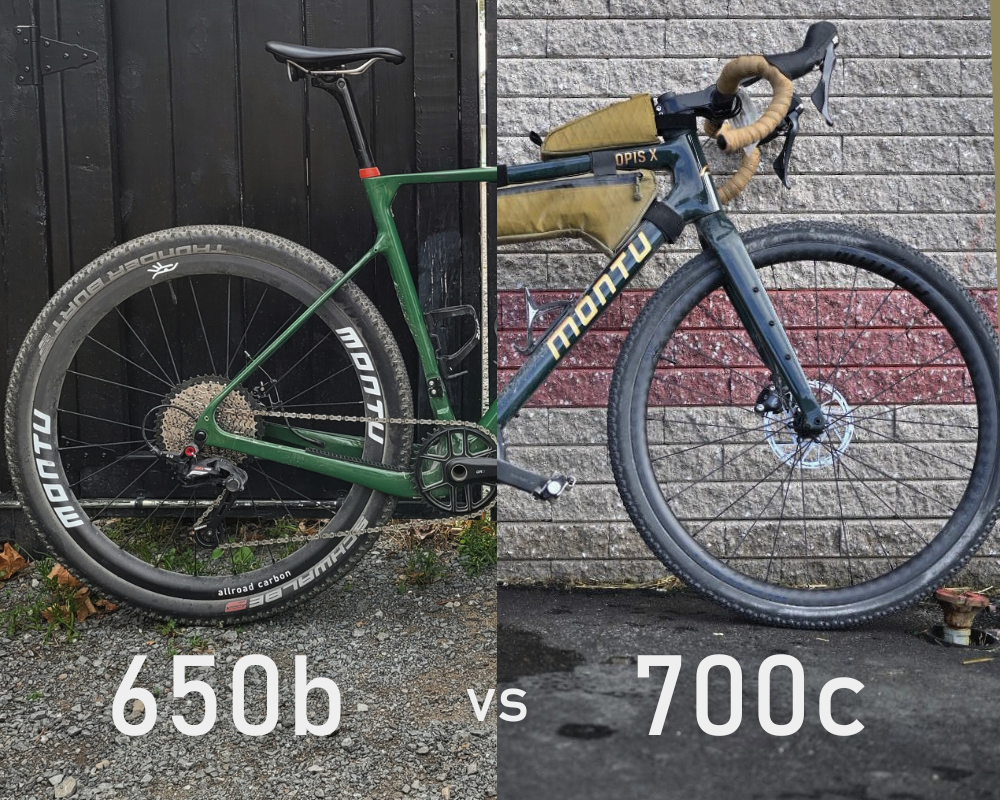
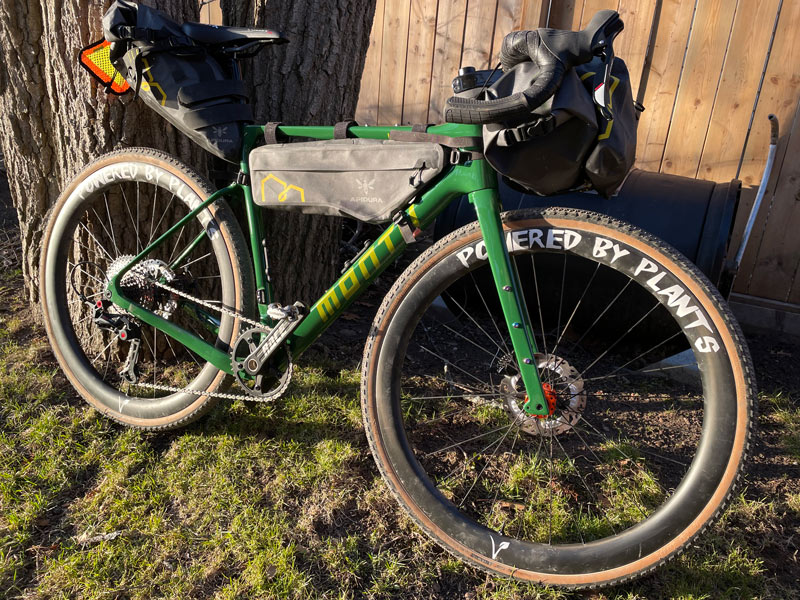
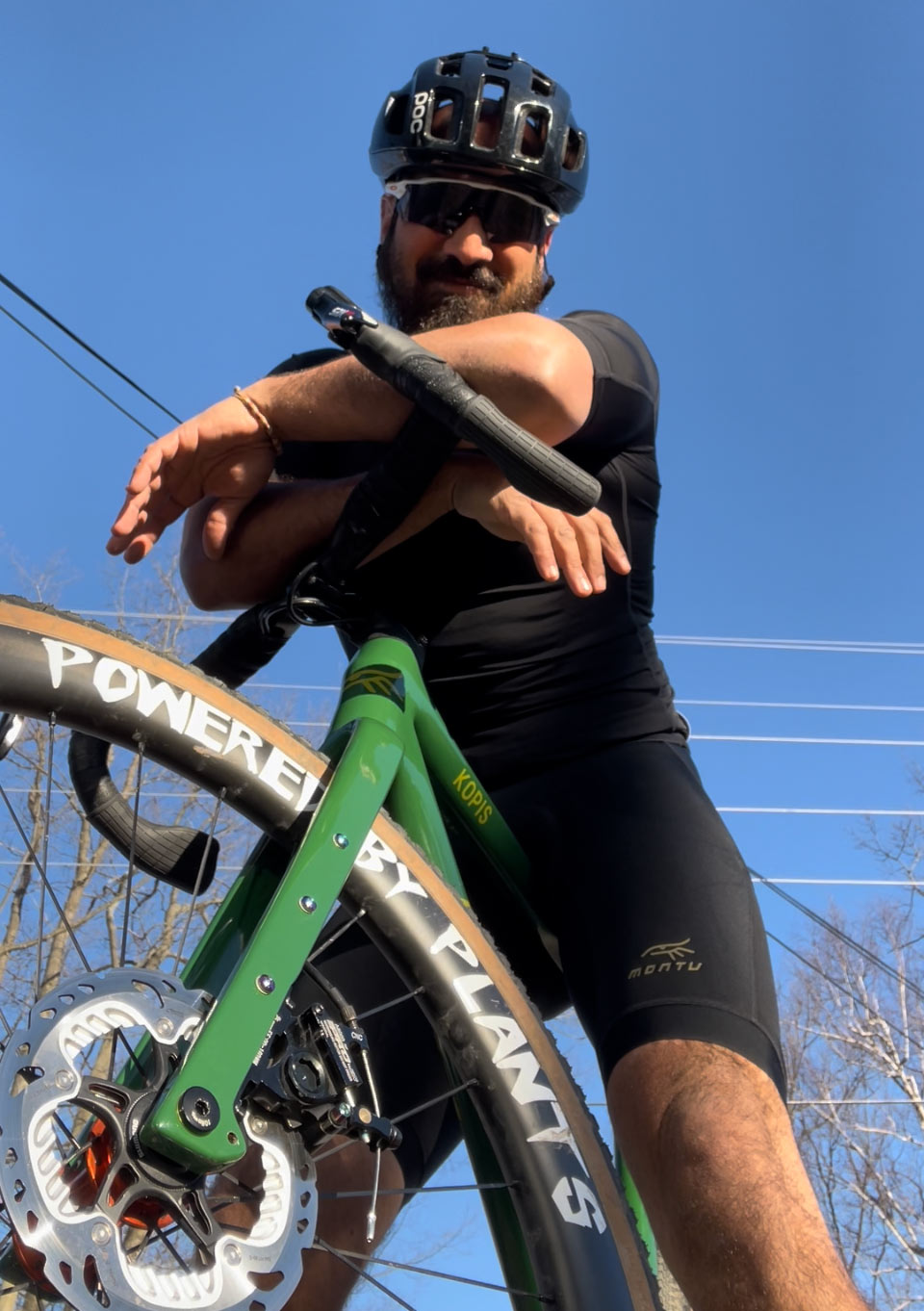
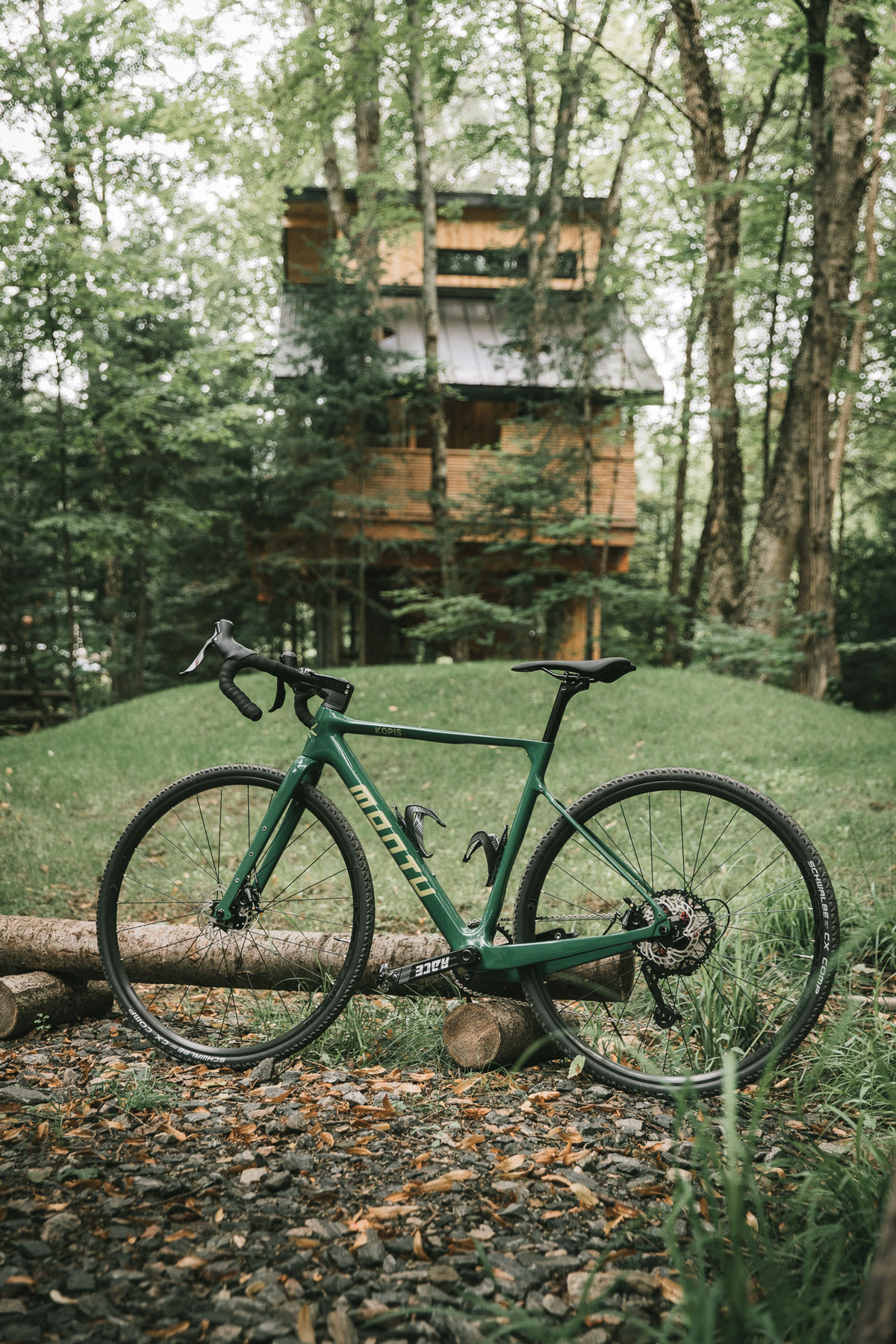
Montu Kopis in 650bx2.1 mode
For the sake of simplicity, we’ll narrow our scope to examining two stock spec choices we use in building Montu Kopis gravel bikes: 650 x 47B and 700 x 40C . We assume, to further simplify matters, that rubber compounds for the tires are identical or differences are negligible. In paragraphs that follow, we’ll discuss performances for both on-road and off-road terrains, as well as the significance of tire pressure in the given wheel sizes. By the end of this article, you should be equipped with a better understanding of which wheel diameter aligns best with your needs.
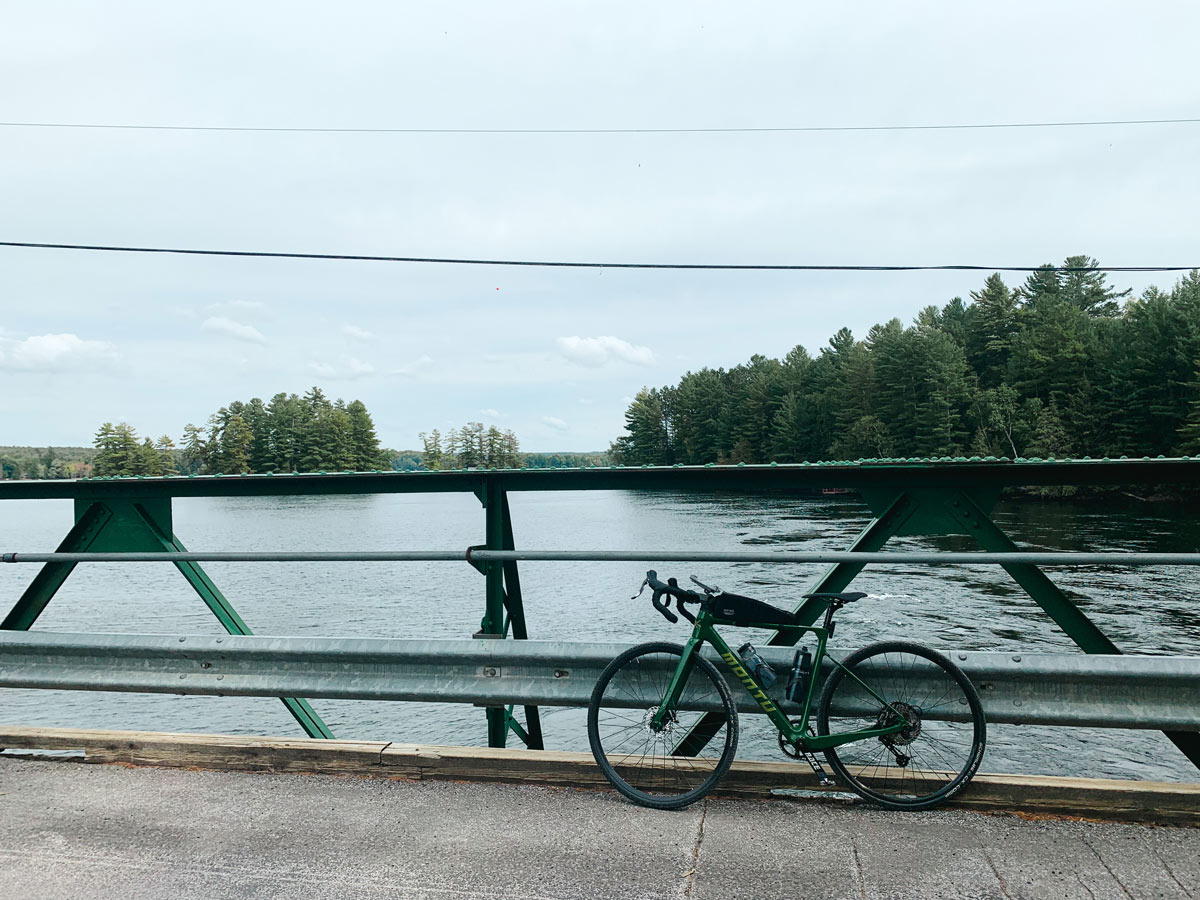
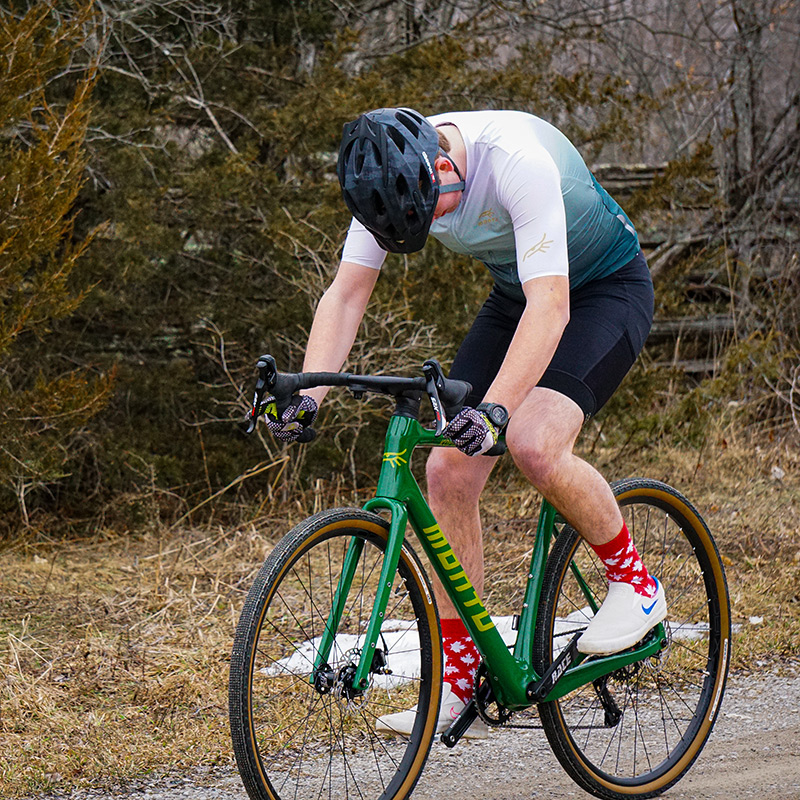
Montu Kopis with Allroad carbon wheels and 700×40 tires
At the outset, it’s important note that there’s no better or worse option — they’re just different. It all depends on which wheel diameter is a better match for your riding style and preferences.
What is 650b and 700c?
The 700c wheel has established itself as the conventional choice for road and gravel bikes. 650b emerged as an attractive alternative tailored to meet the demands of different riding styles. With their ability to accommodate larger tire volumes on modern road and gravel frames, 650b wheels are inflated to lower pressures than your average 700c tire (again, all other things being equal, larger volume tires are inflated to lower pressures than smaller volume ones), this pressure characteristic in itself significantly contributes to the benefits of 650b wheels, which will be discussed further in the following sections.
650b vs 700c Performance: What are the key factors?
In comparing the performance of 650b and 700c wheels in different cycling conditions, it’s important to analyze factors such as rolling resistance, traction, weight, bouncing, and comfort.
Rolling Resistance
Rolling resistance is the energy loss occurring during tire deformation during cycling. This is an inherent characteristic of deformable bodies, such as tires, as they undergo repeated cycles of deformation and recovery. As a result, this energy loss is dissipated as heat and sound.
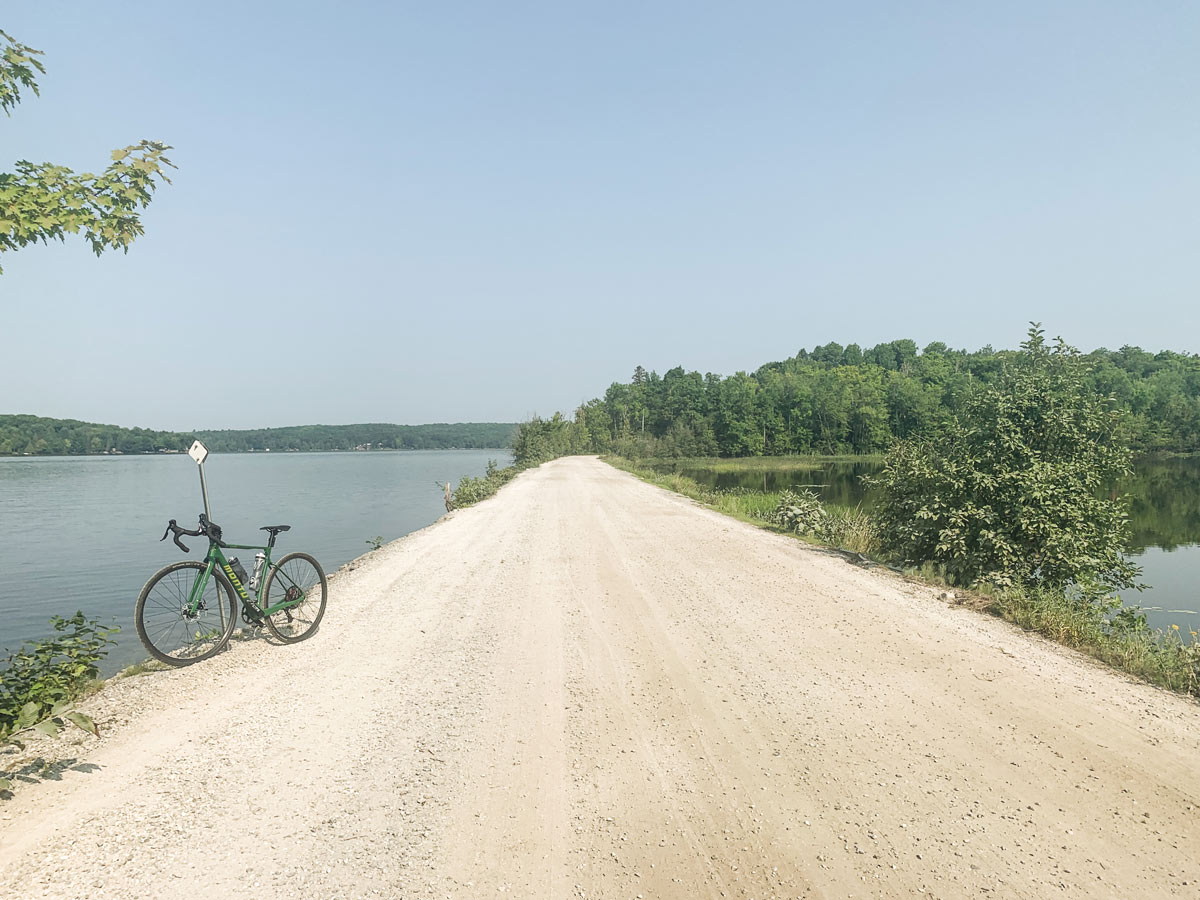
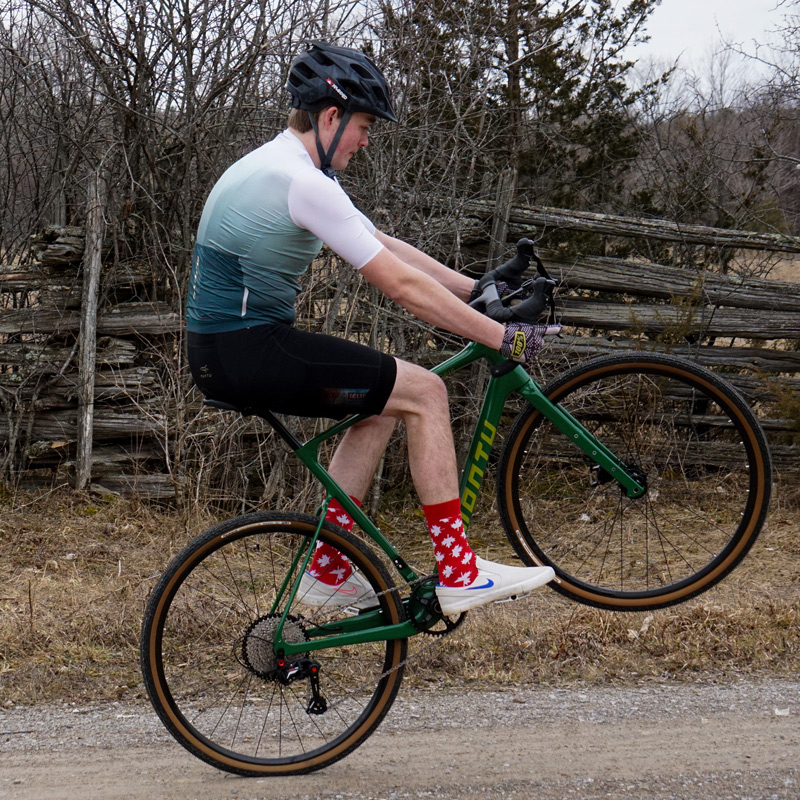
Montu Kopis with 700x45C wheels and tires
As mentioned, 650b tires are typically inflated to lower PSI levels, amplifying what is known in physics as hysteresis loss due to increased tire deformation. With each rotation, the tire operating at lower pressure undergoes more flexing, resulting in more energy dissipation and, thus, higher rolling resistance. This contrasts with 700c tires, often inflated to higher PSI levels, effectively reducing tire deformation under the same load (the cyclist), thus mitigating this energy loss.
Another crucial aspect in understanding rolling resistance is the concept of contact patch, which is the area of the tire in contact with the ground. With the lower tire pressure for 650b wheels, the contact patch expands. This increased contact area increases the maximum coefficient of friction, requiring more watts to maintain forward momentum. In contrast, higher pressure in 700c wheels results in a smaller contact patch, which in turn, decreases rolling resistance. That being said, there is evidence to support that higher volume tires can actually have less rolling resistance than narrower ones*.
Traction
Despite being associated with heightened rolling resistance, 650b wheels offset this downside with improved traction which is favorable in off-road cycling. The lower tire pressure of 650b wheels allows them to conform more effectively to irregularities in rougher terrains, expanding the contact area. Additionally, fitting larger tires in general increases wheel engagement with the surface, offering an advantage in rougher terrain conditions where maintaining traction is necessary. With better traction, you also benefit from increased stability and control with the 650b wheels.
Weight Penalty
Typically, the majority of 650b wheels tend to have a smaller outer diameter relative to 700c wheels, therefore resulting in a lesser weight. This reduced rotating mass of 650b translates to quicker acceleration and deceleration, improving the steering and responsiveness of the bike. And you can imagine how the combination of lighter wheels and better traction also offers advantages in climbing, making the 650b also effective in uphill conditions.
However, because of the lower weight of 650b wheels, it also translates to a lower momentum at a certain velocity. This makes it more challenging to maintain speed as compared to the heavier 700c wheels, which also has the added benefit of lower rolling resistance.
Bouncing and Comfort
Lastly, the choice between 650b and 700c also affects the ride’s comfort and bouncing characteristics. The wider and lower-pressure 650b wheels create an air cushion that improves impact absorption, and lowers the risks of punctures. This can provide a smoother, more comfortable ride on rugged terrains. Conversely, the more rigid feel provided by the higher pressure in 700c tires are ideal if you prefer more direct road feedback.
Conclusion
In summary, 650b stands out for its capability to run at lower pressures, increased traction, and superior comfort which is favorable for riding on technical off-road terrain. Meanwhile, 700C’s lower rolling resistance and higher momentum makes it advantageous for smoother tarmac or mixed-terrain rides where you know you’re not going to encounter very rough terrain, and if you enjoy a more noticeable road feel.
Remember that this comparison goes beyond the notion of “which is better or worse”, but instead offers a deeper understanding of which riding style you prefer.
If you’re still uncertain of your build and considering trying both 650b and 700c options, it’s essential to invest in a frameset with wide tire clearance. Our Montu Kopis frameset has 700 x 50C or 650B x 2.1” tire clearance, which provides the adaptability you need when switching to different wheel sizes. Whether you want to race gravel, explore networks of dirt and gravel roads, or plan multi-terrain epic rides with no certainty of what road conditions are like, the Kopis can do it all. It has the balanced ride you expect from a fast and light gravel bike, and the versatility of a bikepacking and adventure bike.
I ride for the exhilaration of feeling the wind on my face as I bomb down a hill and for the exhaustion my legs feel when climbing it. Some days I ride because I want to escape life; some days I ride because doing so helps me feel as though I’m really living. I ride to keep in top shape, and to delay the usually inevitable morph into a different shape when I eat too much and don’t ride enough.
I ride because I secretly love the tan lines.
I love that my eyes become wider to take in the passing scenery as my heart rate climbs. I love how I can be breathing in the scent of lilac bushes one minute, and the scent of cow manure the next.
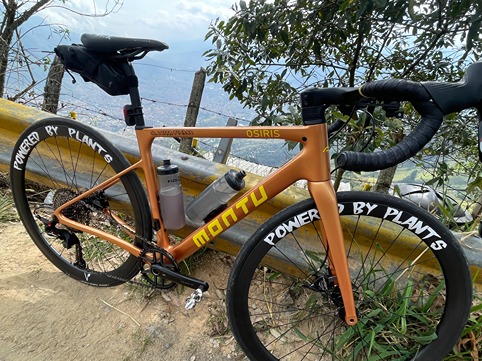
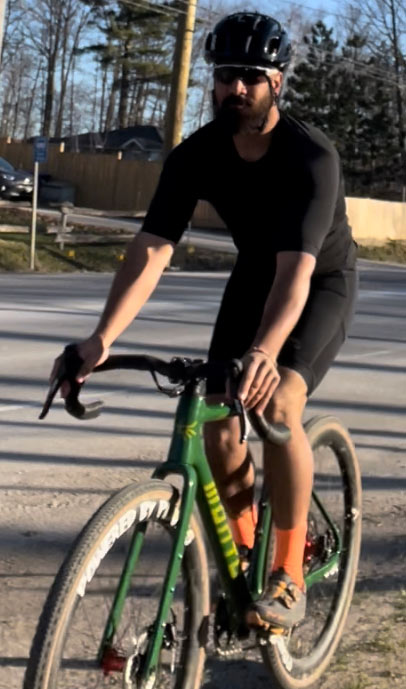
I love that I can get comfy in the drops, go full gas, and feel like I’m at warp speed on the road on my Montu Osiris (yes, that was a rare cycling/Star Trek reference). Other times, I rest comfortably on the tops and meander my way along a dusty gravel trail on my Montu Kopis.
The idea of taking the long way, or the slow way (the latter of which is typically my default) is one that fascinates me. The things I see along the way, the experiences that find me, and the people I meet, usually bring a smile to my face.
And isn’t that what life is about?
On a recent ride I was delighted to find a surprise samosa stop at a random convenience store in a small town. They were great samosas. A great samosa you weren’t expecting to find (especially passing through a small town like this) is the second-best type of samosa—the best type of samosa being the one you know is coming.
These are the moments that add joy to my days. There is a simplicity, even a profundity, in enjoying the little things that come from, and during, an intentional movement practice like cycling. I know people who experience these same things while on a hike, or a run, or something else—the joy of celebrating small victories or experiencing something new that you wouldn’t have if you weren’t going slow enough to notice. I have driven by that same convenience store a dozen times before, for example, never noticing their samosa offerings.
I find a good ride is soothing for the soul, much in the same way that a tough ride can make the soul stronger.
As an aside, for those out there who are vegan (or veg-forward) and fans of samosas, and Star Trek, and cycling, I hope you’ve enjoyed this little write-up. For those of you who aren’t any of those things, I still hope you enjoyed reading, and I invite you to eat more plants. Either way, and no matter who you consider yourself to be, I hope you engage in the beauty that is exploring the long way. For your soul. For your health. For the tan lines.
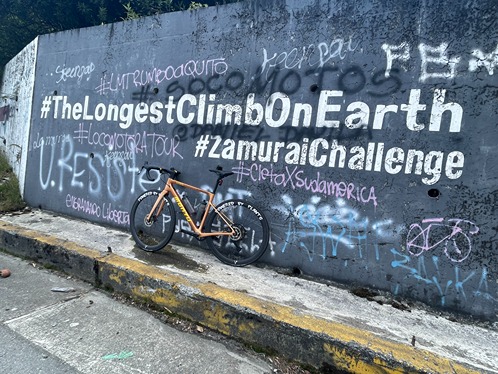
This is an account of climbing the longest road climb in the world, Alro de Letras by Montu ambassador Aaron Prasad
The Preamble
Where to start…Letras was an incredible day.
I sit here nearly two weeks after returning from my month-long trip in Colombia—two and a half weeks after summitting the colossal Alto de Letras road climb (spoiler alert)—and even now when I close my eyes I can vividly see the landscape passing by, feel the air becoming cooler as I got closer to the top, and I still laugh when I think of my adventure partner screaming, “vamanos!” as she pulled away in the support vehicle and raced ahead to our next meetup spot.
The Profile
Let’s talk about the mountain itself. Generally regarded as the world’s longest road cycling climb, Alto de Letras winds up the Andes Mountains from a little town called Mariquita, in the Tolima department (province/state) of Colombia. From the start of the climb to the official summit sign at the end, as per my Garmin, is just shy of 81km in total distance.
Most reports I found conflicted a bit, but according to Strava the climb starts at 465m above sea level and gains over 3600m in total elevation before the summit, finishing at an elevation of almost 3500m above sea level. Many reports and accounts on the internet will say that the average grade is roughly 4%, however that average also includes the descent portions, which bring the average down. The descents provided welcome, although brief, respite from the constant upward effort. I found them to be great opportunities for active recovery, although they don’t appear as often as you’ll find yourself hoping for…just five or six times by my count.
In terms of oxygen availability, we lose roughly 3% for every 300m above sea level we go. So in a climb that gains roughly 3600m, I would have access to 36% less oxygen at the top of the climb compared to the bottom. I was hoping my acclimation period would help me cover the spread.
My approach on the day was to just keep my legs turning in circles (squares when needed) and mostly just using whatever gear allowed me to stay in my 90-100 RPM cadence. I figured even if I had to rely on the easiest possible gear the whole time, making it to the summit sign was all that really mattered. All of the videos and articles on riding Letras (and I did watch and read ALL of them) echoed the same thing: if you’re an amateur (which I definitely am) don’t go too hard out of the gates, and fuel more than you think you need to. I am so glad I followed both pieces of advice.
The Bike
After ordering the Montu Osiris all-road bike late in the fall and having the build completed mid-winter, I hadn’t had the chance to really ride it much before packing it into my travel case and assembling it in Colombia. That didn’t end up being problematic (although it easily could have been) as I had the better part of a month to get used to it before my Letras attempt at the end of February.
My Osiris (which has been named “Pumpkin”) features the Montu one-piece carbon handlebar that originally came with My Montu Kopis build (called “Kale”). The groupset is the new Sensah 12-speed mechanical disc 1x with a 42T chainring and 46T max cassette in back. This provided an ample climbing ratio and generated plenty of puzzled looks while buzzing around the streets and hills of Colombia. The Montu team also came up clutch in a pinch for me, as a part I had sourced didn’t fit properly, and they overnighted a replacement that worked perfectly. The wheels are my own, a carbon 35mm deep profile with 28mm Vittoria Rubino Pro tubeless tires. I never felt as though my equipment came up short, I wish I could say the same for my fitness, though.
The Fuel
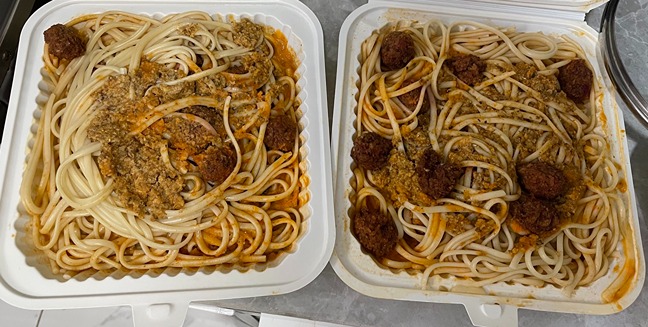
The night before the ride, after a lovely seven-hour road trip from Medellin with my co-pilot and adventure partner, we dined on Spaghetti Bolognese from my favourite café called Las Veganas Restaurante. I was also drinking lots of water with some electrolyte powder through the evening.
The next day started at 4:30am with my standard breakfast for the last several days: water with some electrolytes, bananas, and a protein shake with a bunch of greens powder in it. My nutrition plan was simple enough: to ingest a bit of food every half hour or so in the form of Lara bars and bocadillo cubes (a Colombian cycling food comprised entirely of fruit sugars) along with some other carbohydrate-heavy bars and whatever real food we found along the way. I’m so glad I had my support vehicle to store all the extra water, electrolyte canister, and food. I don’t know how I would’ve managed without her there.
Throughout the ride, I stuck to my plan of eating early, eating often, and drinking an equal balance of electrolyte and water combination. I don’t usually do gels and so I stayed away from them on this occasion as well. This strategy worked well for me, I think. If I could’ve changed anything, it would have been to have more fresh fruit, including lots of bananas, because the bars and sugar cubes got a bit unpleasant after a while. They did the job though.
Oh and in case you’re wondering, we absolutely managed to find French fries along the way. If you don’t know me, all you need to know is that I always find French fries. I didn’t eat too many of those until I reached the top, though, just in case. I also gave some of them to the dog who welcomed us at the sign (I’m pretty sure his name was Letras).
The Ride
My adventure partner and I left the condo in Mariquita at 5:30am, her driving the support vehicle and me hitching a ride until we were safely out of our neighborhood and on the main road which would lead to the base of the climb. There was nothing unsafe about the neighborhood itself, however the streets were not rideable and I didn’t want to start my Letras ride attempt with a punctured tire.
With a few words of encouragement from my partner, off I went. A little nervous but excited.
Every account of the Letras ride that I poured through or watched also echoed this: you know you’re climbing right away, as one of the 10% sections is just a few hundred metres in to the climb. It was a rude awakening, no matter how many times I’d watched other riders tackle it.
By 5:43am I was struck by the following realization…”I can’t believe I’m on Alto de Letras right now.”
Stay open, stay inline, stay engaged.
This was my strategic phrase for the day. Whenever I found my head or body getting carried away, or if I was forgetting to control my breathing, I would bring myself back to this phrase. Keep my shoulders back, elbows bent, chest open; keep my body in control and in a straight line to prevent wasted energy and imbalanced effort; keep my glutes and core engaged so I didn’t burn through the other muscles too quickly. I repeated this phrase along with my personal mantra (which I will not share here) for seven hours, in and out of the saddle. I said other things out loud too, but they don’t belong here, either.
The forecast on that Saturday, February 25th, was rain, off and on, all day. But between that and the following day—thunderstorms all day—it seemed to make the most sense to just go for it. The sun was just peeking through some early morning cloud cover which made for a comfortable temperature at the beginning of the ride. Comfortable for that area of Colombia before 6am of course meant 30 degrees Celsius. I started and maintained my ride strategy of slow and steady, and was relieved when I saw my support vehicle stopped at the first 5km mark for our scheduled meetup. The first 5km out of the way…wow. Only 76km more to go. But still, we celebrated briefly before she sent me away yelling, “vamanos!”
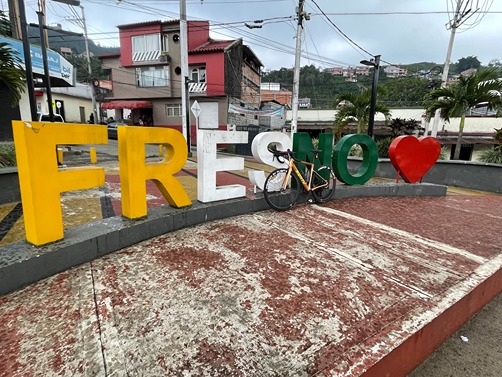
I had made it through the first checkpoint, the little town of Fresno, where a massive 10%+ grade welcomed me, and continued through to send me on my way. This was the first 30kms done.
At kilometer 31 my right hamstring seized in a big way, and I couldn’t bend my leg or put any power out at all. I got off the bike and started massaging the area as best I could. I stretched and relaxed while waiting for the support vehicle to find me. I genuinely thought my day was over. I used everything I had ever learned to help ease the muscle spasm and managed to get it to release enough that it went from a screaming pain to a dull grumble.
I want it on the record here that my partner was a warrior every step of the way, running back and forth to the car to get me anything I asked for and providing constant moral and physical support. As an actual endurance athlete herself, I couldn’t have asked for a more incredible team member, and I genuinely don’t think I could’ve gotten to the top without her. We had already had the discussion in our pre-ride debrief that my body would inevitably fail me in one aspect or another at some point, I had just hoped it wasn’t with 50km left to climb. She sent me off yet again, with a “you got this! Vamanos!”
I wasn’t turning back now, and so with all the effort I could muster I got back on Pumpkin and began ascending again. The next few kilometers were somewhat uncomfortable as I tried to figure out what position allowed my hamstring to settle in for the rest of the day. Stay open, stay inline, stay engaged. I was fighting back tears for the next half hour or so.
My mental strategy from the start was to focus on the total distance of the climb as opposed to focusing on the total elevation gained. For my brain, it seemed to make more sense knowing that the total distance would continue moving forward. I found myself focusing on a few hundred meters at a time to get through the hamstring injury. Letras was no joke.
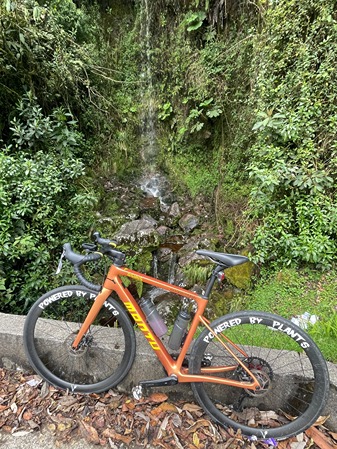
We encountered a rain storm for about 30 minutes in that first third of the ride, but the day actually turned out to be perfect, without rain for the rest and completely clear and sunny. I managed to take in the scenery around me during this section of the ride, and get some bike glamour shots as well, obviously.
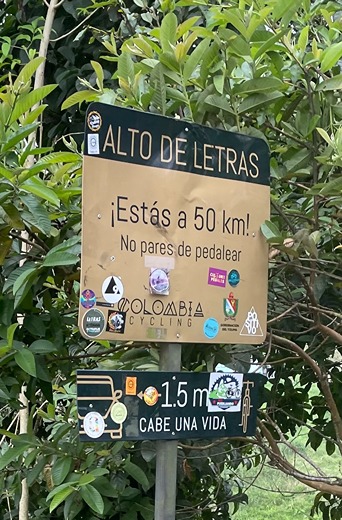
Stay open, stay inline, stay engaged. I kept pushing along, through the 50km mark, where I saw another of these encouraging signs.
At this point, the contour of the route shifted from long steady sections to shorter chunks with switchbacks, providing plenty of opportunity to slow my speed and take in the breathtaking views and the magnificent road condition. I had become aware, however, that I was now in the hardest section of the whole climb, with the highest average grade…and it was about 15kms long. Knowing this, my support partner was ready at every meetup asking how I was feeling and what I needed, before sending me off with another, “vamanos!”
Around the 60km mark was when I first became aware of how much thinner the air felt. I was really worried about that, but after spending the month at 1500m in Medellin, I think my body had acclimated fairly well, and I really didn’t struggle to breathe until the last few kilometers. Many of the videos and articles I poured through also mentioned traffic being a problem, but I didn’t find it to be that challenging. There was plenty of shoulder room for my comfort level, and the traffic is extremely respectful to cyclists in Colombia. Besides, after riding the roads in Medellin (which were chaos) this route was peaceful.
Stay open, stay inline, stay engaged. I was getting closer. I passed the 8km sign. I could feel the energy returning to my body that had come and gone through the ride, and for the first time, I embraced the fact that I would be summiting Alto de Letras today.
Two cars with road bikes attached to each whizzed by me headed down the mountain and gave an encouraging honk. My partner had mentioned earlier in the day that there was a group ahead of me. I finally made it to the top of that grueling section of the climb, greeted by a refreshing descent and this awesome sign:
And not long after, this equally awesome sign:
Again recalling my research, I looked to my left as the descent ended and I began climbing again—this time a slow and steady but comfortable grade to the finish line—knowing that I’d be able to see the summit. I had read repeatedly that it was both encouraging and discouraging at the same time because you can see it, but it’s still a long way off. This was accurate. As mentioned before I was also really feeling the diminished oxygen in the air, as well as the much cooler air temperature.
But I was undeterred. I was summitting Alto de Letras today. I gathered every bit of energy I had left in me and pedaled all the way up into the mountain-top town. My partner and I coordinated the best camera angles to capture the moment, and I attempted a sprint finish for the last 900m. My legs did not agree, so I just cruised up to the official sign at the top of the mythical mountain. With my partner’s crucial support, I had conquered the world’s longest road climb.
Alto de Letras will hold a very dear place in my heart for the foreseeable future, for so many reasons. I consider myself extremely lucky to have gotten the chance to ride it in my cycling lifetime, luckier to have done it with the support of the Montu team and in their gear, on their bike, and luckier still to have shared it with someone who understood exactly what we were in the middle of together the entire day.
I came to cycling quite late in my life after following in the pedal strokes of a close friend who was touting the many joys and fitness benefits of his new favourite hobby. It sounded like a wonderful way to spend time outside, enjoy nature, see places, and spend time with others. So I grabbed a used road bike and started learning…mainly how not to fall over while clipped in. It took a few times.
Since then I’ve gone through several different iterations of my cycling setup, and seven separate steeds before discovering the wicked Montu Kopis, and the Montu philosophy: producing quality garments and bikes that reflect our characters as people, and to assist us in the enjoyment of experiencing the world. I have truly never enjoyed a buying experience so much as when I purchased my Kopis. Not only did I love the beautiful green frame (and how funky that would look with my custom wheelset with orange hubs) and the infinite mounting options that come standard on this build. And holy **** the thing is light.
As a rider, I will never lead the pack in terms of pace, but I do love going for long rides. I’ve learned that one of my favourite things in life is to start a bike ride in one place, and end in another. I also learned that this was an actual thing—bikepacking.
So I thought the best thing for me to do would be to do my first bikepacking trip in a different country. I ordered some gear, packed my bags and a gravel bike, and headed south to Colombia (a bucket list destination for me). I quickly learned what to do and what not to do on my 640km journey along the Caribbean coast, starting and ending in Cartegena.
I’ve also been lucky enough to spend a month in Cape Town, South Africa, where a different bike got me through my first 50km bike race and up and down the various peaks and bays there. It was some of the most incredible geography I’ve ever seen, and included a century trip to Cape Point.
All of this has led me to understand so much more about what I like and need in my bike: generous main triangle frame clearance (for small and large frame bags), lots of attachment points for mounts, fenders, extra bottles, fork cages/bags, and top tube accessories/bags if needed. As the team at Montu will tell you—or as anyone who knows me will tell you—I am an extremely difficult customer to please. I was astounded at how patiently and expertly they broke down all the details for me, including a full geometrical analysis comparing the Kopis to my previous bike, the Norco Search XR.
I also had a custom road wheelset made and I love that I can just swap out my adventure wheels for the road wheels on this frame. So even on this gravel frame with generous tire clearance, I can hit the pavement for a few hours usually to struggle up the local hell-hill, Scenic Caves Road, here in Collingwood, Ontario. That being said, I might give the Montu Osiris road frame a try in the future…you know, ‘cause it’s another bike.
I am incredibly excited to share my story here, and to see what I can accomplish with this new bikepacking/gravel bike in the coming seasons. I hope to be able to share many more experiences with my Kopis!
My cycling journey is really just in its infancy at this point. That said, I’ve always been a big endurance sports enthusiast. Running and Nordic skiing have been my mainstays for so long now I don’t even really consider them “workouts” as much as they are just part of who I am.
Cycling just felt like a natural progression for me. It’s not totally new to me, however, as spinning has always been my studio or gym class of choice and during the pandemic we invested in a Peloton (I know, I know…eye roll). It has been fabulous for a quick workout but definitely won’t ever replace the total elation I get from moving my body outside in nature and fresh air. You just can’t get those endorphins any other way! I also started to feel like my body maybe wasn’t going to allow me to run the way I wanted to run without getting injured anymore so I was keen on finding something that would feel just as good with a less impact in the long term.
The final push was when I started paying attention to what my fellow Nordic skiers were up to in the summer months, turns out they spend a lot of time in the saddle! So, like any die-hard endurance athlete I dove right in and bought myself a beautiful Montu Kopis gravel bike before I’d ever been on a road bike in my life. It did not disappoint.
Once I got over my fear of being clipped in, I was hooked. I’m not a fan of riding on busy county roads so it’s been fabulous exploring new to me back-roads and different areas of the county by bike. One of my biggest struggles living remotely is always having to drive everywhere, so this has been a really nice way to switch up how I’m getting from A to B sometimes. My biggest struggle these days is finding enough time (and strength) to do all the things I love while also running a business and mothering two tiny humans.
I have taken a deep dive back into running this year, to circle back to my comment above I’m learning how to train slowly and consistently to avoid injury and conquer some big goals as I train for my first marathon. With that being said, cycling will likely be more of a supplementary cross-training activity for me this summer. This means not as many rides as I would like but of course, we can’t do it all! We did get our son his first pedal bike this year, so we are really looking forward to some family adventures by bike and of course, I’m always up for a cycling adventure with friends.
As for the future, my hope would be to enter into some distance races. I’ve already been eyeing the Vancouver to Whistler Gran Fondo so perhaps next year cycling will be my focus. In the long-term incorporating cycling into our travels is high on our bucket list of ways to see this beautiful world, sigh, someday!
Lauren lives in Minden Hills, Ontario, where she and her partner run Fort Tree House Co, a business specializing in custom luxury tree homes.
I bought my first mountain bike when I was in grade 10. Shortly after, I went to Camp Fortune with some guys from the local bike shop for a ride on my new bike. It was early spring and there were no lifts open, so that meant we had to ride up. Being in a group I didn’t really have a choice but to follow, and that meant we had to “earn our descents” by slogging up the back trails. I think it was on this ride when I realized how much I enjoy the challenge presented by riding a bicycle off-road.
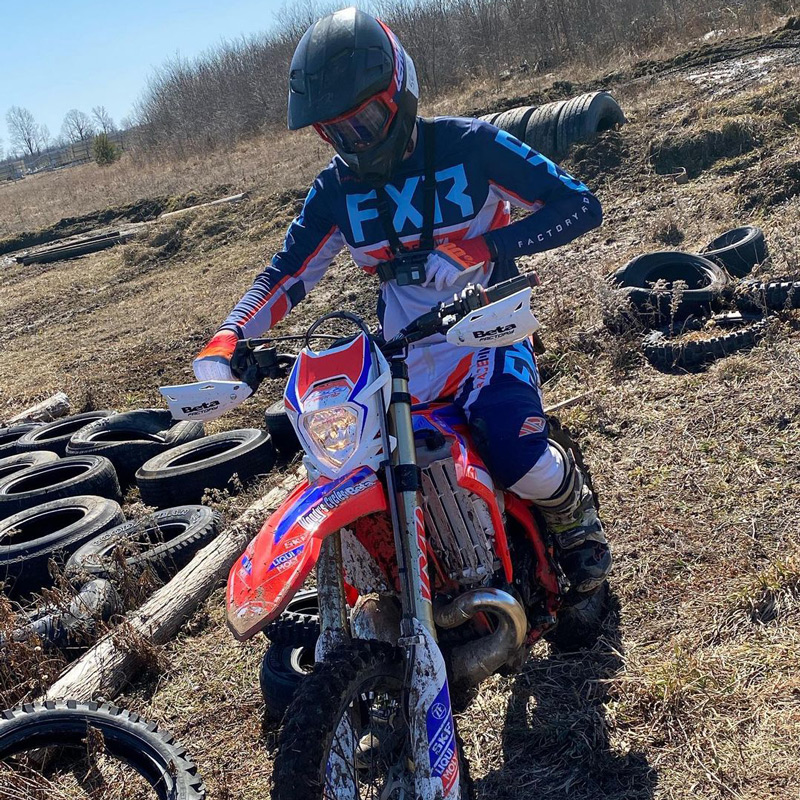
While I love cycling, my lifelong passion has been riding and racing dirt bikes. I always entertained dreams of making it to the top levels of this sport. Four years ago I won my first race 15 minutes ahead of second place. The winter before was spent in the gym and I believe that was a big part of that win. It’s not just about bike handling skills. Even in motorsports, physical readiness makes a huge difference in performance. That’s why cycling is a big part of Enduro (dirt bike racing) pros’ training routines
Since then I’ve become more serious about racing and training in my small home setup. Road and gravel cycling has been on my mind the whole time. Aside from using cycling as great cross-training, I’ve just missed bicycles. In the fall of 2021, I sustained a serious shoulder injury and this was the tipping point in going full circle back to cycling.
Now that my surgery is scheduled all I want to do is ride my Montu Kopis as much as possible to get ready for racing again in 2023. Getting back into cycling has really helped me stay motivated through a long boring winter and made me excited about the future ahead despite my injury.
We’d like to tell you a little more about Montu’s approach to designing technical apparel. Before we do that, we need to place our approach within the broader technical apparel landscape.
What does the global technical apparel market look like?
The global technical clothing and apparel market is both very exciting and very crowded. Innovations in designs and fabrics and increasingly diverse products catering to specific applications and pursuits have come a long way in the last decade. The consumer is spoilt for choice. With such abundance of products, brands and innovations, the downside is that it is often very confusing for the consumer (be that a cyclist, runner or – much like us – someone who enjoys both) to pick gear that really works for what s/he/they need(s). One can set a simple three-point criteria for shopping for technical clothing: features, budget and style.
The technical apparel market also has a high noise to signal ratio. That is, the overcrowding in this market means that companies get into the frenzy of trying very hard to differentiate their product. This is not necessarily a bad thing, but it is often done by means of a needless hyper-segmentation of products, pigeonholing them into very increasingly narrowed down applications and scenarios of use (for instance in cycling: road, mountain biking, gravel, etc. Then take mountain biking: there is XC, downhill, enduro..you get the picture).
So, what exactly is Montu’s approach to technical apparel design? We’ll tell you all about that in our next post, so watch this space!
The world of technical endurance apparel is full of hyperbole, funny acronyms and the smoke and mirrors of marketing gibberish without actual clarity as to what it all means to the consumer. Making functional, beautiful AND affordable apparel is not an easy process, but here is how we go about it without all the needless noise:
Determine the functional “raison d’être” of the item: what usage scenarios is this garment intended for (training/racing/general use), weather conditions, and other contextual details.
Design for function first, then add form: we determine the necessary technical fit and features that the garment should have, then we add our signature subtle yet beautiful design and colours.
Source the most appropriate fabrics for the intended use: We are establishing relationships with the best technical fabric mills in Europe, Taiwan and North Africa.
Out of the lab, and into the world: We then create samples for “real world” usage testing, refine and create the production template. Our philosophy is to focus on what matters to make really good technical and affordable endurance clothing, without all the irrelevant details or marketing overhype.